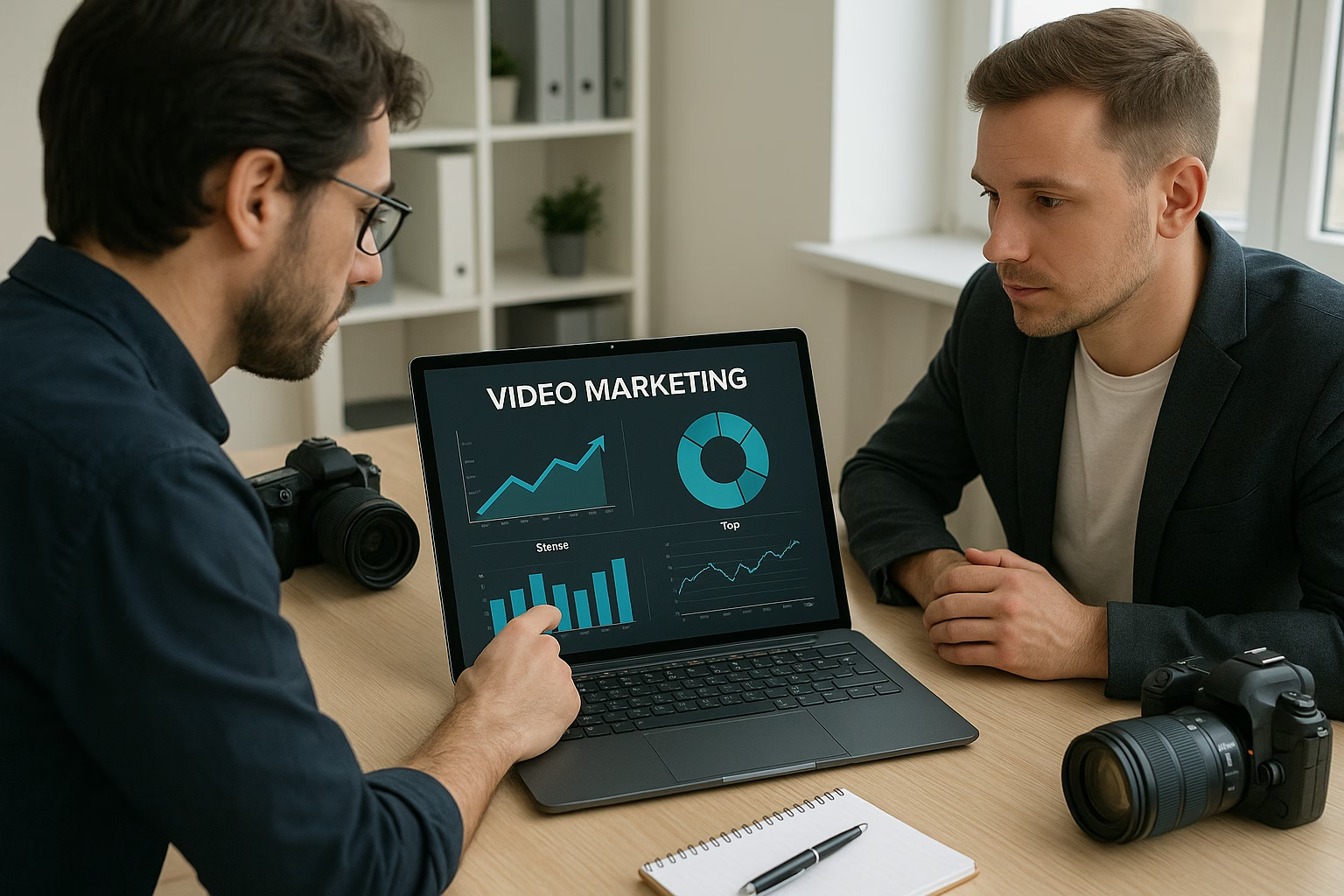
Master Video marketing, marketing optimization essentials for YouTube Growth. Learn proven strategies to start growing your channel with step-by-step guidance for beginners.
Primetime Team
YouTube Growth Experts
November 10, 2025
PT5M
3776
Optimize Your YouTube Channel - Essential Video Marketing
Use a scenario-based video marketing plan to map content to viewer goals: awareness, lead capture, and conversion. Start with clear KPIs, test thumbnails and titles, build retention funnels, repurpose clips for social, and iterate with analytics to improve engagement and growth on your YouTube channel.
Next Steps and How PrimeTime Media Helps
PrimeTime Media specializes in helping creators implement scenario-based video marketing plans with practical templates, production workflows, and A/B testing setups. If you want hands-on support-content calendars, thumbnail systems, or KPI dashboards-PrimeTime Media can audit your channel and provide an optimization strategy built to scale.
Ready to optimize your channel? Contact PrimeTime Media to book a free channel review and get a tailored plan for awareness, lead generation, and sales growth.
YouTube Help Center - Policies, upload guidelines, and technical documentation.
Think with Google - Research and trends on audience behavior and video marketing statistics.
Hootsuite Blog - Social distribution and repurposing tactics to amplify video reach.
Social Media Examiner - Social media strategy ideas and case studies for repurposing video content.
PrimeTime Advantage for Beginner Creators
PrimeTime Media is an AI optimization service that revives old YouTube videos and pre-optimizes new uploads. It continuously monitors your entire library and auto-tests titles, descriptions, and packaging to maximize RPM and subscriber conversion. Unlike legacy toolbars and keyword gadgets (e.g., TubeBuddy, vidIQ, Social Blade style dashboards), PrimeTime acts directly on outcomes-revenue and subs-using live performance signals.
Continuous monitoring detects decays early and revives them with tested title/thumbnail/description updates.
Revenue-share model (50/50 on incremental lift) eliminates upfront risk and aligns incentives.
Optimization focuses on decision-stage intent and retention-not raw keyword stuffing-so RPM and subs rise together.
👉 Maximize Revenue from Your Existing Content Library. Learn more about optimization services: primetime.media
Why a Scenario-Based Plan Works
A scenario-based plan ties specific video formats to viewer intent: discoverability for new audiences, educational series for consideration, and product demos for conversion. This focus helps creators prioritize production time and ad spend, set realistic KPIs, and design clear distribution and repurposing rules so each video serves a measurable goal.
Key Concepts and Definitions
Awareness: Reach and impressions from search, suggested videos, and social distribution.
Consideration: Views and watch time from playlists and series that build trust.
Conversion: Clicks to landing pages, email signups, or product buys tied to CTAs.
Retention Funnel: Sequence of videos crafted to maximize session time and subscribers.
A/B Testing: Systematic tests for thumbnails, titles, and hooks to optimize click-through and retention.
Practical Scenario Examples for YouTube Channels
Match content types to the viewer scenario. For discovery, publish short tutorials and trend-react videos. For consideration, create mini-series and comparison videos. For conversion, produce demos, case studies, and direct CTA videos. Use repurposing-cut clips for TikTok and Instagram-to amplify reach and bring viewers back to your full-length content.
Step-by-Step Optimization Strategy for YouTube
Step 1: Define primary channel goals (brand awareness, lead capture, or sales) and set one KPI per goal, e.g., view growth, email signups, or product purchases.
Step 2: Map 3 viewer scenarios-Discover, Learn, Buy-and list one video format that serves each scenario (short trend video, tutorial, demo).
Step 3: Create a content calendar with a rolling 6-8 video pipeline: mix awareness, consideration, and conversion pieces each week.
Step 4: Design a retention funnel: plan intros, middle hooks, and end-screen CTAs to move viewers to the next video or playlist.
Step 5: Implement A/B tests for thumbnails and titles on new uploads (run variants for at least 24-72 hours) and measure click-through and first 30-60 seconds retention.
Step 6: Track core metrics-CTR, average view duration, audience retention, and conversion events-and use YouTube Analytics weekly to spot trends.
Step 7: Repurpose assets: clip key moments into 15-60 second vertical videos, optimized for social, with a CTA back to the full video.
Step 8: Distribute strategically: pin in community tab, share to niche subreddits or Discord, and embed videos in blog posts or newsletters.
Step 9: Optimize descriptions and chapters for search intent, include timestamps, and link to related videos and playlists to boost session time.
Step 10: Review results monthly, iterate on what improves KPIs, and scale successful formats with a lightweight production template.
Templates and Channels Example
Use a simple channels template: Week A = 2 awareness shorts + 1 long tutorial; Week B = 1 case study + 1 demo + social repurposes. For an example, a creator selling presets could post a short before/after reel (awareness), a tutorial showing installation (consideration), and a walkthrough with a discount code (conversion).
Average view duration and audience retention - content stickiness.
Impressions to view ratio - reach efficiency.
Subscriber growth per video - long-term value.
Conversion rate on CTAs - direct business impact.
Tools and Resources
Start with YouTube Analytics and Creator Studio for core metrics. Use free thumbnail testers, Google Trends for topic validation, and social repurposing tools to batch vertical edits. Learn production basics from our post on production optimization strategies and refine workflow with channel workflow templates.
Distribution and Repurposing Playbook
Publish the long video, then within 24-48 hours release 3 vertical clips across TikTok, Instagram Reels, and YouTube Shorts. Add cards and end screens linking to the playlist. Embed the video in a blog post and newsletter for search and referral traffic. For automation ideas, see our API automation examples.
Beginner FAQs
How do I start an optimization strategy for my YouTube channel?
Start by choosing one channel goal-awareness, leads, or sales-and one KPI. Map three video scenarios (discover, learn, buy), create a 4-8 week content calendar mixing formats, and run simple A/B tests on thumbnails and titles while tracking CTR and retention weekly.
What metrics should new creators focus on first?
Beginners should track impressions, click-through rate, average view duration, and audience retention for each video. These metrics reveal discoverability and engagement problems. Add subscriber growth and conversion events after you stabilize view and retention trends to measure longer-term channel health.
How often should I post to see consistent growth for YouTube channels?
Consistency matters more than volume-start with a realistic schedule like two videos per week (one long, one short) and repurpose clips. Keep that cadence for 8-12 weeks while iterating on thumbnails and hooks, then increase output if metrics and resources allow.
What is a simple A/B test for thumbnails and titles?
Upload a video with one thumbnail and title, then change to a second version within the first 24-72 hours and compare CTR and first-minute retention. Keep tests isolated, run them for a few days, and only change one element at a time to learn what drives clicks and watch time.
🎯 Key Takeaways
Master marketing optimization - Optimize Your YouTube Channel - basics for YouTube Growth
Avoid common mistakes
Build strong foundation
⚠️ Common Mistakes & How to Fix Them
❌ WRONG:
Making every video the same “sales” message and expecting steady growth across discovery and retention channels.
✅ RIGHT:
Segment content by scenario-awareness, consideration, conversion-so each video has a clear viewer purpose and KPI, improving relevance and performance.
💥 IMPACT:
Expect a 20-40% lift in CTR and retention when shifting to scenario-based formats and targeted CTAs within three months.
Proven Scenario-Based Video Marketing Plan for YouTube
Use scenario-driven frameworks to align creative, distribution, and measurement for awareness, lead generation, and sales on your YouTube channel. This plan maps content types to KPIs, prescribes A/B testing for thumbnails and titles, and provides retention funnel playbooks so creators can iterate based on data and scale smarter.
PrimeTime Advantage for Intermediate Creators
PrimeTime Media is an AI optimization service that revives old YouTube videos and pre-optimizes new uploads. It continuously monitors your entire library and auto-tests titles, descriptions, and packaging to maximize RPM and subscriber conversion. Unlike legacy toolbars and keyword gadgets (e.g., TubeBuddy, vidIQ, Social Blade style dashboards), PrimeTime acts directly on outcomes-revenue and subs-using live performance signals.
Continuous monitoring detects decays early and revives them with tested title/thumbnail/description updates.
Revenue-share model (50/50 on incremental lift) eliminates upfront risk and aligns incentives.
Optimization focuses on decision-stage intent and retention-not raw keyword stuffing-so RPM and subs rise together.
👉 Maximize Revenue from Your Existing Content Library. Learn more about optimization services: primetime.media
Overview
This intermediate guide is for creators aged 16-40 who want a practical, scenario-based optimization strategy for YouTube growth. It focuses on three common goals-awareness, lead generation, and sales-and shows how to design content workflows, test thumbnails and titles, measure retention, repurpose, and distribute across platforms for measurable gains.
Framework: Map Scenarios to Goals, Format, and KPIs
Start by defining clear scenarios and the primary KPI for each. Below are three scenario templates with recommended formats, distribution, and success metrics supported by current creator best practices.
Scenario A - Awareness (Top of Funnel)
Primary KPI: Views and impression click-through rate (CTR)
Format: Case studies, demos, customer testimonial videos
Distribution: Targeted playlists for buyers, retargeting via paid ads
Testing focus: Narrative framing, price anchor language in title/intro
Benchmark data: Expect conversion rates 0.5-2% from organic video traffic; higher when combined with retargeting
Step-by-Step Optimization Strategy
Use this ordered workflow to convert scenarios into repeatable test-and-learn cycles. Execute 7-10 steps each campaign to create disciplined growth loops.
Step 1: Define the scenario and one primary KPI. Ensure the KPI is measurable in YouTube Analytics or your tracking URL (UTM).
Step 2: Create a content hypothesis: format, target audience persona, hook, and desired viewer action. Write a hypothesis statement for A/B testing.
Step 3: Produce a 3-video test batch that varies one element only (thumbnails, title, or hook). Keep production variables constant to isolate impact.
Step 4: Launch the batch to comparable upload times and playlists. Use consistent metadata templates across tests for fair comparison.
Step 5: Run A/B tests for thumbnails and titles using sequential testing or experiments via TubeBuddy/TubeMogul. Collect CTR, average view duration, and retention graphs.
Step 6: Analyze 48-72 hour and 14-day performance windows. Prioritize retention curve differences (first 15 seconds and 30-60 second drop points).
Step 7: Implement winning creative elements across the campaign and repurpose top performers into Shorts, clips, and social posts to expand reach.
Step 8: Route engaged viewers into funnels: pinned links, end screens, and email capture using a landing page with UTM tracking to measure conversion attribution.
Step 9: Use paid retargeting for the bottom-funnel audience who watched >50% of product videos. Monitor cost per acquisition (CPA) and adjust bids.
Step 10: Document playbook outcomes, update a channel template for recurring campaigns, and scale the highest ROI formats. Repeat the test cycle quarterly.
Creative Testing Best Practices
Run multi-metric evaluation-CTR vs. watch time tradeoffs-don’t chase CTR alone.
Test thumbnails in groups of 3-5 to gather faster signals, then refine.
Use analytics retention graphs to identify the exact second viewers drop; fix that moment in edits.
Retention Funnels and Playbooks
Retention is the compound interest of YouTube growth. Build funnels that move viewers from discovery to watch next and to conversion using playlist sequencing, chapters, and clear mid-video CTAs.
Retention Playbook Example
Hook: First 10 seconds promise and visual proof.
Value delivery: Deliver 60-80% of promised value before CTA to build trust.
Engagement cue: Ask for a relevant comment between 40-70 seconds to boost interaction signal.
Watch next: Use in-video cards at 60-70% watch progress to guide to playlist content.
Conversion: Place a clear CTA in description and pinned comment with tracked link.
Repurposing and Distribution Systems
To expand reach, convert long-form videos into multiple micro assets. A systemized repurposing pipeline increases impressions without equal production cost.
From each long video produce: 3-6 Shorts, 4-8 social clips, and one blog summary.
Engagement: Average view duration, Relative retention, Likes, Comments
Conversion: Clicks to landing page, Email opt-ins, Purchases, CPA
Operational: Production hours per video, Cost per video, Output consistency
Data-Driven Example
When creators implemented systematic thumbnail A/B tests, channels saw CTR increases of 20-60% within two rounds of testing and corresponding improvements in average view duration due to higher-quality traffic (reported across creator case studies and industry data). For best practices, consult the YouTube Creator Academy and YouTube Help Center.
Tools, Templates, and Channel Examples
Use these tools and templates to operationalize your optimization strategy:
Analytics: YouTube Analytics, Google Analytics
Testing: TubeBuddy, VidIQ for thumbnail and title experiments
Project management: Trello or Notion templates for content calendar and test logs
Why Use a Video Marketing Agency or Specialist
Working with a video marketing specialist or agency can accelerate learning curves-especially for creators scaling to paid funnels. Agencies bring data-driven testing frameworks, production templates, and ad expertise to lower CPA and increase conversions. For high-growth creators, this often pays back via faster funnel optimization.
For actionable support and tailored channel templates, PrimeTime Media builds scenario-specific playbooks, runs A/B tests, and automates repurposing workflows. If you want help implementing this plan, PrimeTime Media can audit your channel, set up experiments, and create a scalable content system-request a consultation to get a custom optimization strategy for your YouTube channel.
Hootsuite Blog - distribution and cross-posting strategies
Intermediate FAQs
How do I prioritize metrics when optimizing for both views and conversions?
Prioritize a primary KPI for your scenario: views for awareness, clicks/opt-ins for lead generation, conversions for sales. Use a secondary KPI (e.g., retention or CTR) to avoid misleading uplift. Track both short-window signals (48-72 hours) and 14-30 day outcomes to validate causality.
How long should I run A/B thumbnail and title tests?
Run experiments for at least 72 hours but analyze again at 14 days to capture recommendation effects. Shorts and trending content may stabilize faster; evergreen long-form needs longer windows. Ensure comparable traffic sources and upload times for fair results.
What’s the best way to repurpose long-form videos into Shorts without losing retention?
Extract the strongest 10-30 second moments with a complete hook and clear value. Add captions, punchy edits, and an on-screen CTA. Use Shorts to funnel viewers back to the long-form video playlist for deeper engagement and measurable watch-time boosts.
How often should I update my channel templates and playbooks?
Review templates quarterly and after major algorithm or audience shifts. Keep a changelog for tests and update playbooks when a consistent winner emerges across three independent experiments. This balances iteration speed with statistical confidence.
🎯 Key Takeaways
Scale marketing optimization - Optimize Your YouTube Channel - in your YouTube Growth practice
Advanced optimization
Proven strategies
⚠️ Common Mistakes & How to Fix Them
❌ WRONG:
Relying solely on CTR when optimizing thumbnails and titles, then assuming more clicks always mean better growth. This ignores retention and leads to low-quality traffic and higher drop-off.
✅ RIGHT:
Optimize for a combined metric set: CTR paired with first-minute retention and 30-day watch time. Prioritize creatives that deliver both high CTR and sustained watch time to signal quality to the algorithm.
💥 IMPACT:
Shifting to CTR+retention optimization can increase meaningful watch time by 15-40% and improve recommendation rates, often leading to 10-25% higher long-term view growth within months.
Optimize Your YouTube Channel - Proven Video Marketing
Optimize Your YouTube Channel - Proven Video Marketing
Use a scenario-driven optimization strategy to align content with specific funnel goals-awareness, lead generation, and sales-by mapping KPIs, running systematic A/B tests on thumbnails and titles, and building retention funnels. This plan scales by automating repurposing, distribution, and analytics to sustain growth and measurable ROI.
YouTube Help Center - Policy and technical documentation for uploads and metadata.
Think with Google - Research-backed consumer insights and video marketing statistics.
Hootsuite Blog - Distribution and social repurposing strategies for videos.
Social Media Examiner - Tactical social marketing techniques to amplify video reach.
PrimeTime Advantage for Advanced Creators
PrimeTime Media is an AI optimization service that revives old YouTube videos and pre-optimizes new uploads. It continuously monitors your entire library and auto-tests titles, descriptions, and packaging to maximize RPM and subscriber conversion. Unlike legacy toolbars and keyword gadgets (e.g., TubeBuddy, vidIQ, Social Blade style dashboards), PrimeTime acts directly on outcomes-revenue and subs-using live performance signals.
Continuous monitoring detects decays early and revives them with tested title/thumbnail/description updates.
Revenue-share model (50/50 on incremental lift) eliminates upfront risk and aligns incentives.
Optimization focuses on decision-stage intent and retention-not raw keyword stuffing-so RPM and subs rise together.
👉 Maximize Revenue from Your Existing Content Library. Learn more about optimization services: primetime.media
Overview and Goals
Advanced creators need a reproducible framework that treats every video as an experiment. Identify which scenario each video targets (top-funnel awareness, mid-funnel consideration, or bottom-funnel conversion), then apply a tailored optimization playbook. This approach turns creative output into predictable performance using data, testing cadence, and automation.
Key Components of the Scenario-Based Optimization Strategy
Scenario Mapping: Label videos by funnel stage and business objective before production.
Hypothesis-Driven Tests: Create testable hypotheses for thumbnails, titles, hooks, and CTAs.
KPI Playbooks: Define precise metrics: impressions CTR, 0-15s retention, 30-60s retention, unique viewers, watch time per impression, conversion rate, and cost per lead.
Retention Funnels: Design video series and playlist structures to maximize session time and sequential watch.
Distribution Systems: Automate cross-posting, repurposing, and push strategies to external platforms and owned channels.
Scaling Automation: Use templates, batch production, and API-driven uploads to scale reliably.
Actionable Framework
Step 1: Define your scenarios by mapping content to funnel stages and the target KPI (e.g., awareness = impressions and CTR; lead gen = clickthrough-to-landing-page).
Step 2: Build creative hypothesis cards: one hypothesis per variable (thumbnail, title, intro) and a measurable success threshold for 14-day performance.
Step 3: Create production templates and a channels template for rapid iteration, including intro variants, hook lengths, and mid-roll CTA placements.
Step 4: Run parallel A/B thumbnail and title tests using traffic-splitting or sequential uploads; measure CTR and first 30-second retention as primary signals.
Step 5: Implement retention funnels via playlists and end-screen sequences; use suggested-playlist ordering to encourage sequential watch and increase session duration.
Step 6: Deploy automation for repurposing: clip highlights for Shorts, create audiograms for socials, and batch transcriptions for SEO and republishing.
Step 7: Integrate analytics pipelines that combine YouTube data with CRM and ad platforms to measure conversions and true cost per acquisition.
Step 8: Iterate on underperforming cohorts by adjusting thumbnails, hook, and early pacing; prioritize experiments that move the 0-15s retention needle.
Step 9: Scale winning templates by batching production, delegating edits, and creating a content calendar focused on high-ROI scenarios.
Step 10: Institutionalize learnings into a living playbook and handoffs for teammates or a video marketing agency partner to maintain consistency at scale.
Optimization Tactics and Technical Details
Advanced optimization requires instrumenting experiments and reading causal signals rather than surface metrics. Combine impression-to-watch ratios, audience overlap analysis, and cohort retention. Use traffic source breakdowns to tailor intros: search viewers prefer immediate context; suggested viewers need curiosity-driven hooks. Leverage YouTube’s timestamps and chapters to measure micro-engagement.
Testing Matrix Examples
Thumbnail Tests: Minimal text vs. bold text; face close-up vs. contextual scene; color saturation variations.
Title Tests: Benefit-first vs. curiosity-first; keyword-rich for search vs. emotional for suggested discovery.
Hook Tests: 3-second payoff vs. 10-second story setup; immediate promise vs. narrative tease.
Call-to-Action Tests: In-video link vs. pinned comment vs. end-screen overlay for conversions.
Data and Automation Stack
For reliable scaling use a modular stack: YouTube API + analytics warehouse (BigQuery), BI dashboard, and an automation layer for uploads and metadata updates. This supports bulk A/B tests, channel-wide metadata audits, and automated republishing. For workflow speed, see production optimization strategies and automation examples like those in PrimeTime Media’s advanced guides.
Distribution and Repurposing Playbook
Primary upload: long-form optimized for session time and SEO.
Secondary assets: Shorts and clips targeted by persona to drive channel subscriptions.
Owned distribution: newsletter clips and community posts to convert engaged viewers to leads.
Paid promotion: target lookalike audiences for top-performing scenarios to expand reach efficiently.
Scaling Team and Outsourcing
Create role-specific SOPs for editors, thumbnail designers, and ad specialists. A reliable video marketing agency or video marketing specialist can handle iterative tests and scaling if you lack in-house capacity. PrimeTime Media combines production optimization with data-first marketing optimization to run these experiments efficiently and scale channels with repeatable templates and channel examples.
Measurement and KPI Playbooks
Build playbooks per scenario with clear thresholds: awareness videos should target >5% impressions CTR and lift in unique reach; consideration videos should move watch time per impression; conversion videos must be measured by landing page conversion and CPA. Use statistical significance thresholds for tests and require at least 14 days of data and a minimum sample size before rolling winners into templates.
Advanced Repurposing Systems
Reduce marginal cost by automating clipping, caption generation, and variant rendering. Keep a reuse ledger that records which clips performed by persona and platform. Use those performance signals to prioritize which long-form videos become Shorts or Instagram Reels to maximize distribution efficiency.
PrimeTime Media pairs production optimization with a data-first marketing optimization framework built for creators. If you want predictable scaling, our teams provide channel templates, experiment design, and automation that convert views into leads and revenue. Contact PrimeTime Media to audit your scenario mapping and create a customized optimization strategy for your YouTube channels.
Advanced FAQs
How do I prioritize tests across multiple channels and content pillars?
Prioritize by expected business impact: test variables that affect the funnel stage KPI most (e.g., thumbnail for awareness, hook for retention). Use a weighted roadmap scoring reach, conversion upside, and resource cost. Run tests sequentially across channels or parallel with traffic splits to control variance.
What sample size and duration should I use for thumbnail and title A/B tests?
Aim for at least two weeks and a minimum of several thousand impressions per variant depending on CTR variance. Ensure statistical significance using a proper calculator, and require consistent directionality across traffic sources before scaling a winner into production templates.
How can I connect YouTube metrics to actual revenue and lead gen funnels?
Link YouTube click-throughs to tracked landing pages with UTM parameters and server-side conversions, then import conversions into your BI system. Combine watch-time segments with CRM events to calculate true cost per lead and lifetime value attributed to video-driven cohorts.
Which retention metrics are most actionable for mid-funnel optimization?
Focus on 0-15s drop-off, 30-second retention, and average view percentage by cohort. These metrics reveal hook effectiveness, pacing issues, and content depth. Optimize the first 10-30 seconds to reduce early churn and calibrate mid-roll placements to maintain momentum.
How do I scale a high-performing channel template without losing quality?
Codify the template: creative brief, thumbnail rules, hook scripts, and editing presets. Train editors and automate variant renders to preserve aesthetic. Use a QA checklist and phased rollouts so the template scales while you collect performance feedback and avoid creative degradation.
🎯 Key Takeaways
Expert marketing optimization - Optimize Your YouTube Channel - techniques for YouTube Growth
Maximum impact
Industry-leading results
❌ WRONG:
Running creativity without labeling video scenarios and testing randomly; treating each upload as a one-off creative piece without measurement or hypothesis.
✅ RIGHT:
Assign each video to a funnel scenario, state a measurable hypothesis, and run tightly scoped A/B tests with pre-defined success thresholds and sample sizes.
💥 IMPACT:
Correcting this approach typically increases test win rates and channel ROI; expect a 10-30 percent uplift in impressions CTR and a 15-25 percent improvement in early retention within three months when disciplined experimentation is applied.