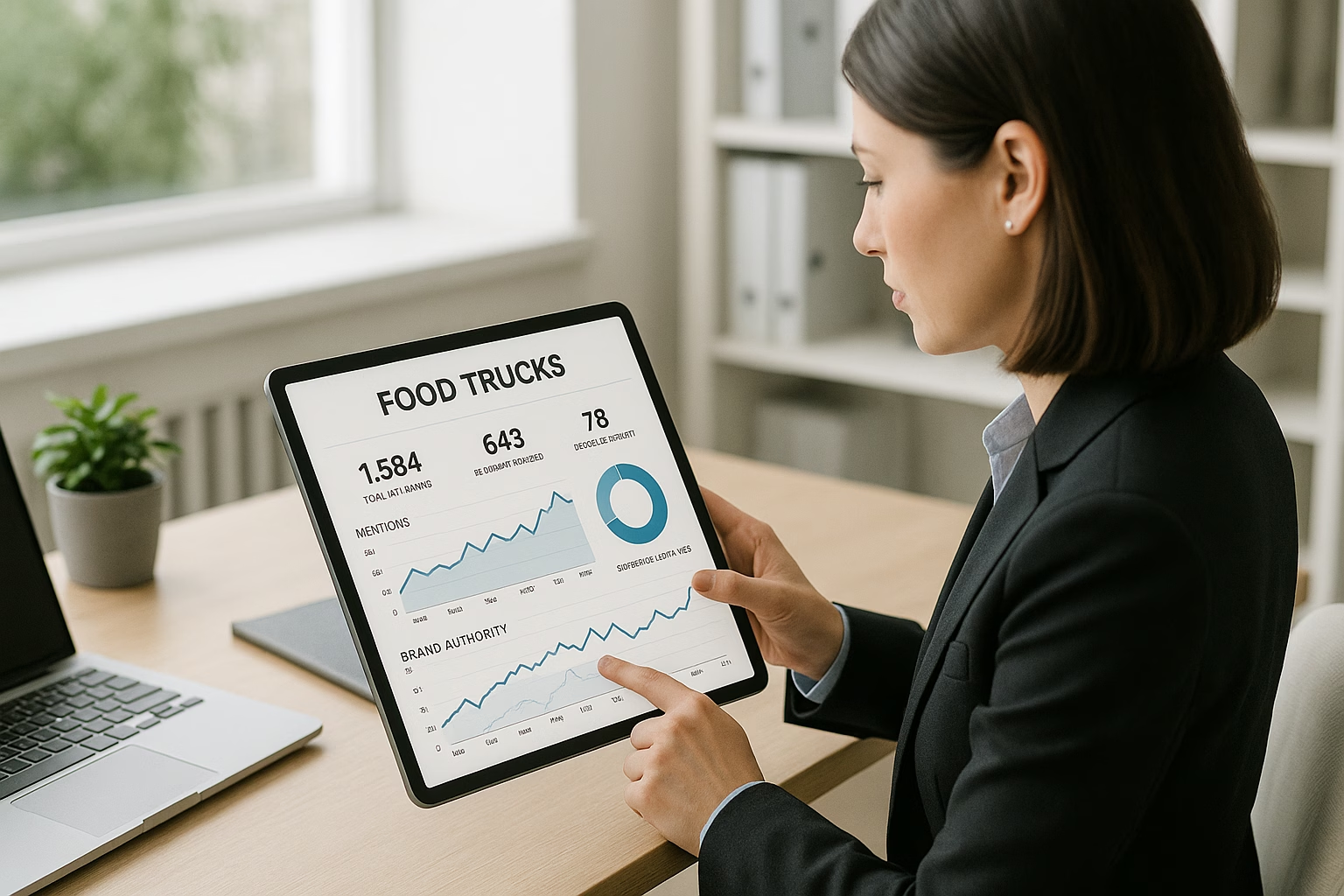
Master Video content, content roi essentials for YouTube Growth. Learn proven strategies to start growing your channel with step-by-step guidance for beginners.
Primetime Team
YouTube Growth Experts
February 4, 2026
PT6M
3817
Proven ROI Blueprint - Video Content for Food Truck
Turn YouTube videos into measurable sales for your food truck by focusing on simple funnel steps: attract local viewers, keep attention, drive actions (menu clicks, directions, orders), and track conversion metrics. This blueprint covers retention-driven editing, CTA placement, KPI tracking, A/B testing thumbnails, and real examples to lift content roi.
How do I measure content ROI for a food truck using YouTube?
Measure content ROI by tracking specific actions: map clicks, phone taps, coupon code redemptions, and direct orders after video views. Compare revenue from those actions against production and ad costs. Use unique codes and simple POS tags to attribute offline sales to YouTube campaigns reliably.
What is ROI in digital marketing and how does it apply to video?
ROI in digital marketing is profit divided by marketing cost. For video, calculate revenue tied to video-driven actions and subtract video production and ad spend. This lets you determine if a video campaign earned more than it cost and informs future roi optimization and budget decisions.
What are easy video content examples that convert for food trucks?
Effective examples include 30-60 second menu highlights, limited-time offer promos with coupon codes, customer reaction clips, and “where to find us” location shorts. These formats focus attention quickly, contain clear CTAs, and are easy to test with small ad boosts for fast feedback.
PrimeTime Media specializes in turning local video content into measurable sales for food truck owners and creators. We blend proven YouTube best practices with simple KPI templates, thumbnail testing workflows, and funnel-focused edits so creators spend less time guessing and more time selling. Ready to raise your video roi? Reach out to PrimeTime Media for a free content audit and practical next steps tailored to your truck brand and local audience.
PrimeTime Advantage for Beginner Creators
PrimeTime Media is an AI optimization service that revives old YouTube videos and pre-optimizes new uploads. It continuously monitors your entire library and auto-tests titles, descriptions, and packaging to maximize RPM and subscriber conversion. Unlike legacy toolbars and keyword gadgets (e.g., TubeBuddy, vidIQ, Social Blade style dashboards), PrimeTime acts directly on outcomes-revenue and subs-using live performance signals.
Continuous monitoring detects decays early and revives them with tested title/thumbnail/description updates.
Revenue-share model (50/50 on incremental lift) eliminates upfront risk and aligns incentives.
Optimization focuses on decision-stage intent and retention-not raw keyword stuffing-so RPM and subs rise together.
👉 Maximize Revenue from Your Existing Content Library. Learn more about optimization services: primetime.media
Why ROI matters for food truck creators
Food trucks rely on local foot traffic and repeat customers. Video content that converts can increase daily sales, shorten marketing cycles, and reduce ad waste. Focusing on content roi and roi optimization for YouTube helps you spend less to get more orders-vital when margins are tight and every location day counts.
Core concepts explained
Content ROI (what it is): Revenue or value generated from the time and money spent producing video content.
KPIs to track: Views, watch time, click-through rate (CTR), call-to-action clicks, map clicks, coupon redemptions, and sales lift.
Organic vs Paid: Organic grows your channel and brand; paid ads accelerate local reach and test offers fast.
Examples of video content that drive sales
Short menu showcases highlighting a signature dish with a clear CTA to “Find us today” and map link.
Behind-the-scenes prep clips that build trust and brand personality, leading to repeat visits.
Limited-time offer promos with coupon codes tracked to YouTube (e.g., “YTFREE5” for $5 off).
Customer reaction videos and testimonials capturing social proof to increase conversions.
7 Steps to Improve Video Content ROI for Food Trucks
Step 1: Define a single conversion goal per video (e.g., map clicks, coupon use, phone orders) so you can measure impact precisely.
Step 2: Target local search keywords in titles and descriptions like your city + food type to capture nearby viewers ready to visit.
Step 3: Hook viewers in the first 5 seconds with a clear reason to stay-show the dish, price, or an urgent offer right away.
Step 4: Use retention-driven edits: quick cuts, close-up food shots, captions for sound-off viewers, and a visible CTA at 10-20 seconds and again at the end.
Step 5: Add trackable CTAs-Google Maps links, phone number tap, and unique coupon codes in the video description and pinned comment.
Step 6: A/B test thumbnails and titles for CTR; compare a lifestyle thumbnail versus product close-up and run side-by-side for 7-14 days.
Step 7: Measure results weekly: tie YouTube analytics to actions (CTR, watch time) and offline sales using coupon redemptions and point-of-sale tags.
Step 8: Mix organic storytelling with small paid Local campaigns to scale offers that performed well organically.
Step 9: Optimize based on data: double down on videos with strong video roi, re-edit clips into shorts, and plan more content around winning formats.
Practical KPI template (simple)
Video Title
Views
Average View Duration
Watch Percentage
CTR (thumbnail/title)
CTA clicks (map, phone, coupon)
Attributed sales (coupon redemptions / POS tag)
Content ROI = (Attributed Sales - Production + Ad Spend) / (Production + Ad Spend)
Editing tips that improve roi optimization
Keep videos 30-90 seconds for promos; 3-6 minutes for storytelling. Shorter formats drive faster actions.
Use captions and on-screen CTAs-many viewers are mobile and muted.
Start with the payoff: reveal the food or discount early to reduce dropoff.
Create a consistent visual brand: truck colors, logo placement, and a repeatable end-screen CTA.
Paid vs Organic spend model
Start with organic testing: publish videos and monitor organic performance for 2-4 weeks. Promote top performers with small local ad budgets to expand reach and measure incremental sales. Track ad spend by campaign and calculate video roi by comparing incremental sales to ad and production costs-this is roi optimization in action.
A/B thumbnail testing process
Create two distinct thumbnails (close-up food vs. context/truck shot).
Run each for a set period with organic promotion or small ad boosts.
Compare CTR and downstream CTA clicks; keep the winner and iterate.
Tools and integrations
YouTube Studio for analytics and CTR data
Google Analytics for tracking landing pages linked from video descriptions
Simple spreadsheet for KPI tracking
POS coupon reports to tie offline sales to video campaigns
Real-world examples
Brands examples: A taco truck posts a 45-second “secret sauce” video with a coupon code in the description. After A/B thumbnail testing, the close-up food thumbnail doubled CTR and coupon redemptions rose 22% that week. For more food truck video formats, see 7 Easy Food Truck Videos Ideas for YouTube Growth.
Measurement and the “what is roi in digital marketing” connection
What is roi in digital marketing? It’s the ratio of profit from marketing efforts divided by marketing cost. Apply this to video roi: track revenue from video-driven actions (coupons, map clicks) and compare to production and ad cost. Use small controlled tests to estimate impact before scaling.
Beginner FAQs
🎯 Key Takeaways
Master Video content and content roi - ROI Blueprint - Optimize basics for YouTube Growth
Avoid common mistakes
Build strong foundation
⚠️ Common Mistakes & How to Fix Them
❌ WRONG:
Posting long, generic videos without a single conversion goal and expecting immediate sales uplift.
✅ RIGHT:
Create short, goal-focused clips with clear CTAs (map click or coupon) and a unique code to measure redemptions and sales.
💥 IMPACT:
Switching to goal-focused clips can improve CTA click rates by 2x and increase measurable sales attributed to videos by 15-30% in a month.
ROI Blueprint - Proven Video Content for Food Truck Sales
Convert YouTube views into measurable sales by aligning video content with a clear funnel, retention-driven edits, and KPI-based testing. This ROI Blueprint shows creators how to track content roi, run cost-versus-conversion models, and A/B test thumbnails and CTAs to increase foot traffic and mobile orders for a food truck.
PrimeTime Advantage for Intermediate Creators
PrimeTime Media is an AI optimization service that revives old YouTube videos and pre-optimizes new uploads. It continuously monitors your entire library and auto-tests titles, descriptions, and packaging to maximize RPM and subscriber conversion. Unlike legacy toolbars and keyword gadgets (e.g., TubeBuddy, vidIQ, Social Blade style dashboards), PrimeTime acts directly on outcomes-revenue and subs-using live performance signals.
Continuous monitoring detects decays early and revives them with tested title/thumbnail/description updates.
Revenue-share model (50/50 on incremental lift) eliminates upfront risk and aligns incentives.
Optimization focuses on decision-stage intent and retention-not raw keyword stuffing-so RPM and subs rise together.
👉 Maximize Revenue from Your Existing Content Library. Learn more about optimization services: primetime.media
Why this matters for creators and food truck owners
Food truck brands rely on local discoverability and impulse purchases. Video marketing roi for YouTube is measurable: a 1% lift in CTA conversion can produce outsized revenue for low-overhead operations like trucks. Focused optimization for video content turns casual viewers into lunchtime customers through targeted targeting, retention, and clear calls to action.
Retention-Driven Editing: Hook in 3-7 seconds, scene cuts every 1-3 seconds for fast food pacing, and end screens with clear location CTAs.
KPI Tracking: Views, Average View Duration, Click-Through Rate (CTR), Conversion Rate (visit or order), Revenue per View.
Ad vs Organic Spend Model: Blend 30-50% promotion for launch/weekly specials with organic content to sustain growth and lower cost per sale.
Testing Framework: A/B thumbnail, CTA wording, and first 15 seconds edits to maximize watch-through and clicks to ordering links or maps.
Audience Funnels and Targeting
Map content types to funnel stages and target them via YouTube interests, local keywords, and community posts. Use Shorts and reels for top-of-funnel discovery, longer value-packed how-to or behind-the-scenes videos for consideration, and hyper-local call-to-action videos tied to Google Maps pins and order links for conversion.
For planning cadence and simple scheduling, see PrimeTime Media's recommended approach and the YouTube content calendar basics to structure local promotions and recurring themes.
Retention-Driven Editing Tactics
Retention correlates strongly with algorithmic visibility. Aim for these editing metrics:
First 3-7 seconds: immediate visual hook (food sizzle, timer, or customer reaction).
Cut frequency: 1-3 second pacing during service moments to create energy.
Mid-roll value: highlight unique menu items at 30% and 60% marks to re-engage viewers.
End CTA: location tag plus a concise incentive (free topping, limited coupon code).
7-Step Implementation Plan (How to Convert Video ROI into Sales)
Step 1: Define your conversion event - in-person visit, online order, newsletter signup, or map click. Attach a baseline value to each (average spend per visit).
Step 2: Set up tracking - use UTM-tagged links in video descriptions, link-shorteners with click analytics, and Google Analytics events for orders and direction clicks.
Step 3: Create three video templates: Short promo (15-30s), Menu deep-dive (60-120s), Testimonial/Review (45-90s). Produce each with consistent branding assets.
Step 4: Launch a thumbnail and opening edit A/B test for the Short promo. Run each variant against a 2-3 day promotion window to gather meaningful CTR and retention data.
Step 5: Promote selectively - allocate a budget split (e.g., 40% launch ads, 60% organic push). Use location targeting and interest segments aligned with nearby events or lunch hours.
Step 6: Measure and calculate content ROI - (Revenue attributed to video − Cost of video + Promotion) ÷ Cost = content roi. Track cost-per-visit and revenue-per-view monthly to detect trends.
Step 7: Iterate based on data - double down on thumbnails and hooks that increase CTR and watch-through. Pause underperforming ad creatives and reallocate budget to proven formats.
Step 8: Scale with lookalike audiences and local interest targeting for ad campaigns, while maintaining a steady stream of organic Shorts to feed discovery.
Step 9: Layer partnerships - collaborate with truck brands, local influencers, and nearby businesses for cross-promotion to expand reach with low marginal cost.
Step 10: Document and standardize what works. Build a reusable content template library so new videos require less time to produce while maintaining high conversion features.
Ad vs Organic Spend Model (Simple Example)
Example budget for a local campaign: $300 monthly ad spend driving targeted Shorts promos + $0-$150 production overhead (repurposed clips). If each converted visit is $12 average spend and you drive 40 attributable visits, revenue = $480; net = $480 − $450 = $30; content roi = 6.7%. Optimize thumbnails and CTAs to increase conversion to 60 visits and content roi rises to 33%.
Metrics and KPI Tracking Template
Views per Video
Average View Duration (AVD)
Audience Retention at 15/30/60s
CTR on thumbnails and CTAs
Click-to-Map or Click-to-Order rate
Conversion Rate to Sale
Revenue per View and Cost per Conversion
Set weekly dashboards in Google Sheets or Data Studio pulling YouTube Analytics and link-click data to calculate content roi trends. For granular best practices, consult YouTube Creator Academy and official policy notes at the YouTube Help Center.
Testing Playbook - Thumbnails, CTAs, and Hooks
Run controlled A/B tests: keep one variable per test (thumbnail image, title wording, opening 3-7s). Measure lift by CTR and 30-second retention. Social proof thumbnails and close-up food imagery typically boost CTR by 10-25% in local campaigns - test to validate for your brand.
Video marketing roi benchmarks vary: typical small local campaigns report video roi of 5-30% depending on production and targeting efficiency. Average CTRs for effective thumbnails are often 4-8% on local promos; aim for 5%+ CTR and 20-40% 30-second retention for higher visibility.
Creative Examples of Video Content That Convert
Geo-targeted lunchtime Shorts showing "On the lot now" + location pin.
Behind-the-scenes prep demonstrating freshness and limited runs.
Menu cross-sell clips highlighting combo upgrades with price and CTA.
Local collab videos with nearby stores or events to tap existing audiences.
PrimeTime Media focuses on creator-friendly production and ROI optimization for local brands like food trucks. We combine data-first testing with snackable creative formats that resonate with Gen Z and Millennial audiences. Ready to turn views into customers? Contact PrimeTime Media for a free channel audit and conversion plan tailored to your truck brand.
Data Sources and Further Reading
YouTube Creator Academy - Official best practices on audience retention and video structure.
Hootsuite Blog - Scheduling, community management, and measurement tips.
Intermediate FAQs
What is ROI in digital marketing and how does it apply to food truck videos?
What is ROI in digital marketing? ROI measures revenue gained versus cost invested. For food truck videos, calculate revenue from attributed visits/orders minus production and promotion cost, then divide by total cost. This gives a clear content roi percentage to compare creatives and budgets.
How do I calculate content ROI for YouTube videos?
Calculate content ROI by attributing direct conversions (orders, map clicks) to video views, summing revenue, subtracting production plus ad spend, and dividing by total cost. Use UTMs and link analytics to ensure accuracy. Monitor monthly to spot trends and optimize spend.
Which YouTube metrics most influence video marketing ROI for food trucks?
Key metrics: Click-Through Rate (thumbnail/title), Average View Duration, 30-second retention, click-to-map or order rate, and conversion rate. These metrics predict how many viewers will follow through to a sale, helping you optimize video roi and creative choices.
How long before I see ROI from optimization for food truck videos?
Typical timelines range from 3-8 weeks. Quick wins (thumbnail and CTA tests) can improve conversions in days; broader channel changes and audience growth take 4-8 weeks to stabilize. Consistency and iterative testing shorten the path to positive content roi.
🎯 Key Takeaways
Scale Video content and content roi - ROI Blueprint - Optimize in your YouTube Growth practice
Advanced optimization
Proven strategies
⚠️ Common Mistakes & How to Fix Them
❌ WRONG:
Relying only on vanity metrics like views without tracking click-to-order or map clicks. High views with no conversion leave revenue on the table.
✅ RIGHT:
Measure and attribute conversions with UTM links, shorteners, and event tracking. Tie every campaign to a clear conversion metric (visit, order, signup).
💥 IMPACT:
Correcting attribution typically improves measured conversion by 15-40% and reduces cost-per-sale as you reallocate spend to converting creatives.
Master ROI Blueprint - Video content for Food Truck Sales
Direct answer: Use a data-first ROI Blueprint that ties YouTube video content to a sales funnel: track view-to-action conversions, A/B test thumbnails and CTAs, allocate ad spend by CPA, and scale winning formats. This approach turns engaging food truck videos into predictable, measurable revenue for your truck brand.
Why ROI Optimization for YouTube Matters for Food Truck Brands
Food truck creators face a unique mix of hyper-local demand and impulse purchases. YouTube can drive awareness, schedule-following, and direct sales, but only if you optimize for content roi from production to post, blending organic retention tactics with paid amplification. This blueprint is for creators who want repeatable revenue, not vanity metrics.
What is ROI in digital marketing and how does it apply to food trucks?
What is ROI in digital marketing: ROI is revenue minus cost divided by cost; for food trucks it measures sales attributed to video minus production and ad spend. Use tracked conversions like coupon redemptions and UTM-tagged orders to compute accurate content roi and justify ad budgets.
How do you measure video marketing ROI for YouTube specifically?
Measure video marketing ROI by linking YouTube metrics to conversion events: CTR, view-through conversions, and unique promo code redemptions. Reconcile YouTube Analytics with Google Analytics and POS data to calculate revenue per view and ROAS, isolating organic vs paid contribution to video roi.
What are the best KPIs to track for optimization for food truck sales?
Track CTR to SIMA, conversion rate of viewers to visits, CPA, revenue per visit, and CLV for repeat customers. Monitor watch time and retention spikes around CTAs to optimize creative. These KPIs provide a holistic content roi view and guide spend allocation.
How should I allocate ad spend between prospecting and remarketing?
Allocate roughly 60% to prospecting (local intent), 30% to remarketing (engaged viewers), and 10% for creative experiments. Adjust based on CPA trends: increase remarketing if remarketing CPA is significantly lower, and scale prospecting when funnel fill is low.
What is the quickest way to improve video roi with thumbnails and titles?
Run controlled A/B tests with one variable change at a time: expression, close-up food shot, or utility headline. Measure CTR and conversion rate to SIMA. Reallocate spend to the winner and implement across similar videos to rapidly improve content roi.
PrimeTime Media is an AI optimization service that revives old YouTube videos and pre-optimizes new uploads. It continuously monitors your entire library and auto-tests titles, descriptions, and packaging to maximize RPM and subscriber conversion. Unlike legacy toolbars and keyword gadgets (e.g., TubeBuddy, vidIQ, Social Blade style dashboards), PrimeTime acts directly on outcomes-revenue and subs-using live performance signals.
Continuous monitoring detects decays early and revives them with tested title/thumbnail/description updates.
Revenue-share model (50/50 on incremental lift) eliminates upfront risk and aligns incentives.
Optimization focuses on decision-stage intent and retention-not raw keyword stuffing-so RPM and subs rise together.
👉 Maximize Revenue from Your Existing Content Library. Learn more about optimization services: primetime.media
Core Concepts: Metrics, Funnels, and Attribution
View-to-Visit Rate: Percentage of viewers who take an action: map clicks to Google Maps, ordering links, and online menus.
Conversion per Impression (CPI): Combines paid and organic impressions to measure efficiency across channels.
Customer Lifetime Value (CLV): For regular customers, estimate repeat visit value to justify higher CAC for new customer acquisition.
Sales-Weighted Retention: Prioritize watch-time segments that historically convert to store visits within 7 days.
Advanced ROI Optimization Framework
This framework focuses on closing the loop between YouTube video content and measurable food truck revenue through structured testing, analytics, and scalable spend models.
Audience and Funnel Design
Target intent-based cohorts: locals, event-goers, and niche food fans (e.g., vegan tacos). Use YouTube affinity and custom intent audiences to reach them.
Map content to funnel stages: Discovery (teasers), Consideration (menu deep dives), Conversion (time-limited offers, order links).
Embed trackable offers: unique coupon codes, UTM-tagged ordering links, and Geo-fenced promos to attribute offline sales.
Retention-Driven Editing Tactics
Open with a visual hook (3 seconds): showcase the food sizzle or a unique truck sign to trigger local curiosity.
Use mid-roll micro-CTA at 30-45 seconds to capture intent without harming retention for high-converting formats.
Edit for retention curves: tighten pacing after 15 seconds and create rewatchable micro-moments for algorithmic boosts.
Thumbnail and Title A/B Testing at Scale
Systematize thumbnail experiments with clear hypotheses: emotion vs. utility, close-up food shots vs. brand context. Run parallel tests across similar audience segments and shift creative weight toward the top-performing variants using an allocation model (80/20 principle) to limit spend waste.
Step-by-Step How to Execute the ROI Blueprint
Step 1: Define your single most important action (SIMA) - a trackable conversion like "map visit", coupon redemption, or online order with a UTM tag.
Step 2: Build a 90-day experimental calendar linking content types to funnel stages, referencing seasonal events and local foot traffic patterns.
Step 3: Produce modular content blocks: 15s hook, 45s story, 10s CTA - this enables reassembly into multiple formats for ads and shorts.
Step 4: Instrument tracking: use UTM parameters, unique coupon codes, and Google Analytics goals; integrate offline POS codes for reconciliation.
Step 5: Launch A/B thumbnail tests and two headline variants; run experiments for at least 7-14 days or until statistical significance is reached.
Step 6: Run a blended ad model: 60% prospecting with local intent audiences, 30% remarketing to engaged viewers, 10% experiments for new creatives.
Step 7: Analyze cohorts weekly: view duration, click-through rate, conversion rate, and CPA; pivot creatives and spend to high ROI combos.
Step 8: Scale winning creatives with controlled budget increments (25% weekly) while monitoring marginal CPA changes to avoid diminishing returns.
Step 9: Institutionalize learnings: create a KPI dashboard and playbooks for thumbnail design, editing templates, and ad copy that delivered top content roi.
Step 10: Expand channels: syndicate high-ROI video cuts to Shorts, Instagram Reels, and TikTok with platform-optimized CTAs to diversify acquisition while keeping attribution tags.
Performance Models: Ad vs Organic Spend
Break-even CPA model: Set a CPA target based on SIMA and CLV. Use spreadsheet scenarios for high, medium, low CLV assumptions.
Lift-based budget allocation: Increase paid spend on creatives that show week-over-week lift in conversions per impression.
Organic scaling: Re-optimize top-performing video metadata and playlists to extend organic lifespan and reduce paid dependence.
KPI Tracking Template (Practical)
Impressions, Views, View-Through Rate (VTR)
Click-Through Rate (CTR) to SIMA
Conversion Rate (CR) and Cost Per Conversion (CPC)
Revenue per Visit and Estimated CLV
Return on Ad Spend (ROAS) and overall content roi
Examples and Case Uses for Truck Brands
Use examples of video content such as 'menu reveal', 'day-in-the-life', and 'event highlights' to match local intent. For template inspiration and beginner tactics, see PrimeTime Media's "7 Easy Food Truck Videos Ideas for YouTube Growth" and production basics in "4 Essential video basics - Tips to Get Started".
Scaling Playbook for Gen Z and Millennial Audiences
Gen Z and Millennials favor authenticity, shareable micro-moments, and social proof. Use behind-the-scenes prep, creator collaborations, and hyper-local challenges. Repurpose vertical cuts for Shorts and pair with tight CTAs like “Claim this Taco via code TACO15” to convert social buzz into foot traffic.
For workflow efficiency, PrimeTime Media helps creators adopt repeatable production systems and analytics dashboards. If you want help turning winning videos into a scaled, revenue-focused channel, PrimeTime Media offers tailored ROI audits and campaign builds. Contact PrimeTime Media to schedule a strategy session and start converting views into consistent sales.
Advanced FAQs
🎯 Key Takeaways
Expert Video content and content roi - ROI Blueprint - Optimize techniques for YouTube Growth
Maximum impact
Industry-leading results
❌ WRONG:
Relying solely on view counts and likes to judge success. That encourages vanity-focused content and misses conversion optimization, causing wasted ad spend and low real sales impact.
✅ RIGHT:
Focus on conversion events (UTM-tagged clicks, coupon redemptions, map visits) and retention metrics. Optimize creative specifically for the SIMA and use A/B tests to iterate thumbnails and CTAs.
💥 IMPACT:
Correcting this approach can reduce CPA by 25-50% and increase trackable revenue by 30-100% within 90 days for most food truck campaigns.